



Cedric the Entertainer, Taraji P. Henson, Ruben Santiago-Hudson, and Joshua Boone bring warmth, wit, strength, and spiritual weight to Debbie Allen’s powerful revival of August Wilson’s Joe Turner’s Come and Gone.
I love live theater. I love Broadway. I love dramas. I love musicals. I love the avant-garde. I love the classics. I love old-fashioned theater. I love the strange stuff, the big stuff, the quiet stuff, and the plays that simply trust actors, language, and light.
There is something magical about a theater space being transformed into a playwright’s ideas, a director’s vision, and the living, breathing talent of actors. When it works, there is nothing like it. The moment is singular. The energy is palpable. Even when something goes wrong, it’s magic. You cannot capture live theater in the same way again.
Joe Turner’s Come and Gone is a beautifully acted, deeply human revival of an August Wilson play that still speaks with force.
It is funny. It is warm. It is haunting. It is spiritual. It is grounded. It is full of people who feel like people.
I’ve seen many Broadway shows. My first was A Chorus Line in 1975, when I was a very young girl. My second was Dreamgirls with Jennifer Holliday in 1981, so the bar has always been high. Since then, I’ve seen countless shows on Broadway and Off-Broadway. Every season I see dozens of productions, and often I’ll see a show more than once because I know that exact performance will never exist again.
My highest count is five times for Jamie Lloyd’s reimagining of Sunset Boulevard, starring Nicole Scherzinger as Norma Desmond and Tom Francis as Joe Gillis. That production completely reshaped how we experience the Andrew Lloyd Webber musical. Close behind is the Broadway revival of Sweeney Todd: The Demon Barber of Fleet Street, during Aaron Tveit and Sutton Foster’s run, which I saw four times.
When theater is good, it is very, very good. I cannot get enough of it.
When it is bad, it is torture. I have only walked out of maybe two shows in my life. One was Julie Taymor’s The Green Bird. I left at intermission because I remember thinking, I will never get that time back again. I cannot remember the other show, but I remember leaving. I must have blocked it out. And even when something does not resonate with me emotionally, I still appreciate the hard work. Theater takes craft. It takes labor. It takes people giving themselves over to a world that only exists for those few hours.
All that being said, while I was sitting in Joe Turner’s Come and Gone, I thought to myself: when can I see this show again?
Other Critics Are Calling It…
Critics have been responding strongly to this Broadway revival, especially the direction by Debbie Allen, the cast, and the power of August Wilson’s writing.
Deadline called the production “a full-on reminder of Wilson’s singular genius,” praising the way the play blends naturalism with memory, spirituality, history, and the lingering presence of the past. The review also singled out the “no-weak-link cast,” including Taraji P. Henson in her Broadway debut, Cedric the Entertainer, Ruben Santiago-Hudson, and Joshua Boone.
The production has also been praised for its creative team, including David Gallo’s scenic design, Paul Tazewell’s costumes, Stacey Derosier’s lighting, and Justin Ellington’s sound.
And that makes sense to me, because what I saw on stage felt deeply cared for… I went up to Debbie Allen on opening night and said, “You created a house that felt warm and welcoming, with a beautiful, strong Black loving couple.” I was fanning out a bit… I think that’s what I said. Ha!
August Wilson’s World
August Wilson is one of America’s great playwrights. His work stands among the finest in American theater. Ma Rainey’s Black Bottom, Fences, The Piano Lesson, and Joe Turner’s Come and Gone are not just plays. They are cultural moments, slices of time. Each is a record. They are memory, music, history, grief, humor, pain, and survival placed in rooms where people talk, fight, laugh, love, and reveal themselves.
Joe Turner’s Come and Gone is part of Wilson’s Pittsburgh series; it is set in 1911 in a Pittsburgh boarding house run by Seth and Bertha Holly. It takes place during a period when many Black people were traveling, searching, migrating, arriving, leaving, and trying to understand what freedom meant after slavery and its aftermath had already marked their lives.
Wilson’s play does not turn our history into a lecture. He puts it into his people. Into conversations. Into meals. Into jokes. Into grief. Into a song. Into a man looking for his wife.
Debbie Allen’s Direction
The production is clear and easy to understand. It does not wrap itself up in unnecessary lighting sequences or theatrical tricks. There is one moment when the production moves into slow-motion, and I loved it. But overall, the words and behavior are the thing.
There is a love you can feel in how this play was treated.
When a Black woman directs a play about Black people with care, the lens is different. We are not made harsh. We are not flattened. We are not reduced to suffering or spectacle. We are presented as human beings with a full spectrum of emotions: vulnerability, power, love, jealousy, acceptance, understanding, compassion, curiosity, humor, and pain.
The characters are complicated, but they are not punished for being human.
That is important.
The Play
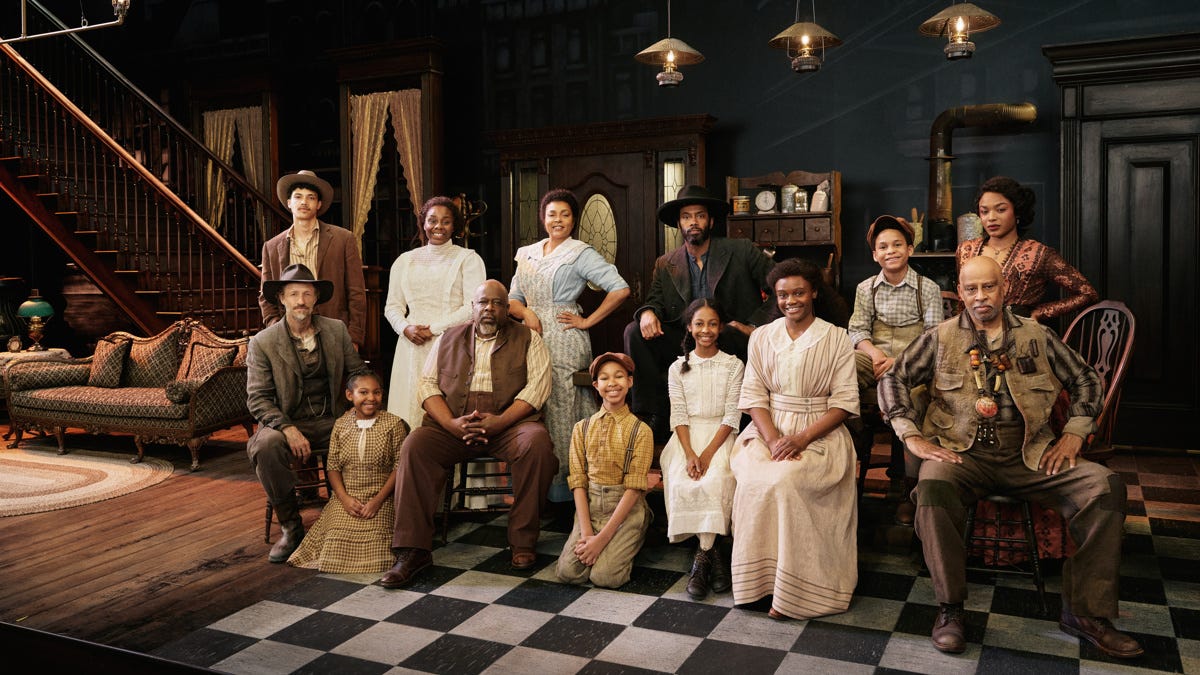
The first thing I noticed was the set. When you come into the theater, there is no curtain, so it’s there… and it’s a feast for your eyes. David Gallo’s scenic design was beautiful because it felt like a real place. It felt traditional in the best way. Sometimes, theater leans into abstraction, and sometimes that works. Sometimes it does not. I thought about the Death of a Salesman production with Wendell Pierce, which had a more abstract stage design. For me, that staging distracted from the living room, the kitchen, the home where Willy Loman lived with his family.
This set did not distract me. It brought me in. It was a boarding house that felt like a home. There was a kitchen, with a long kitchen table, the heart of the house. A more formal living room, center stage was a door… where you could see the silhouettes of those coming and going.
There were doorways leading outside to the backyard and to other rooms. People entered and exited constantly. And then there were these stairs. At first, I noticed how treacherous they looked, and then I started wondering what they meant. Were they a metaphor? A way to show the movement between the public and private spaces of the house? A path to rest, sex, escape, or retreat? Or were they ascending to someone who was higher?! Or maybe I am overcomplicating things, and they were just simply part of the architecture of the production?
I would love to ask Debbie Allen about those stairs. Whatever the intent, the house worked. It gave the characters somewhere to be. It gave the story a body.
Seth and Bertha
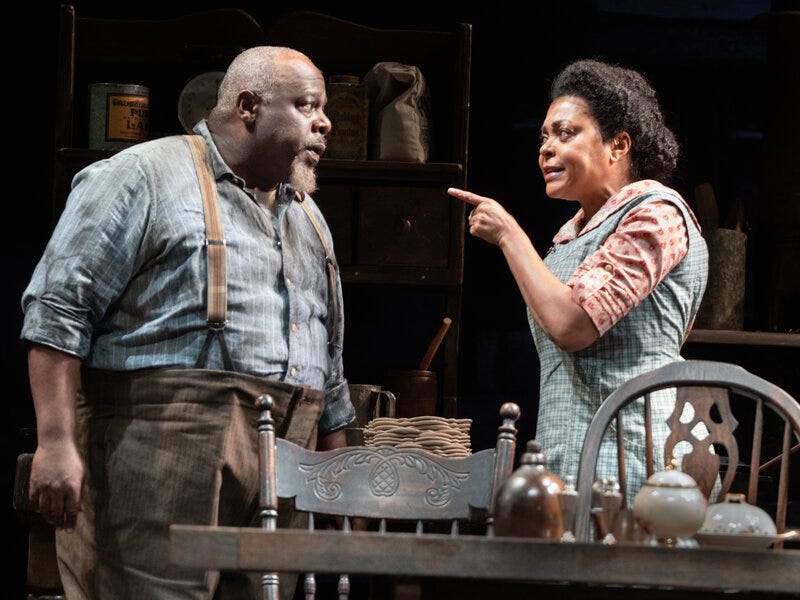
Cedric the Entertainer and Taraji P. Henson had an amazing rapport. I believed they were a couple. I believed they had spent more than two decades together. I believed they had love, rhythm, history, frustration, and a private language between them.
I really want people to see that… their partnership and laughter. A home built by two people who know each other deeply.I love watching a Black couple love each other on stage. That’s why, for me, the emotional center of the production was Seth and Bertha Holly. Sure, I loved the kitchen… but Taraji P. Henson gave it life. At one point, Bertha is making biscuits at the table, talking and making them, and the flour kicks up into the air. She used the biscuit dough for emphasis. I smiled, because how many times have I personally seen or done that… quite a few. It was not a fake stage gesture. It felt lived in. Taraji’s Bertha was comfortable there. She flicked her towel. She moved her hips. She worked in the kitchen like a woman who knew every inch of that space. The cooking wasn’t just business, and the prepping and using the pots and pans were not just props. They were part of her world.
Taraji’s Bertha was the heart of the house. She listened. She helped. She offered advice. She reminded people to find their laughter. She was joy, but not soft in a weak way. She had strength, steadiness, and presence.
Cedric’s Seth is probably not highly educated, but he is very smart. He knows how to negotiate. He knows how to compute numbers. He understands wages, money, work, and how to make the right moves to protect what he has built. That kind of intelligence is not always presented with this much care in literature or theater, especially for a Black working man.
Cedric was wonderful. He was funny, warm, serious, and commanding. His timing was impeccable. He brought humor, but he also brought authority. Seth is the man of the house, and Cedric made you feel that.
Together, Seth and Bertha created something larger than a boarding house. They created a place where people could arrive with whatever they were carrying.
They were strict with boundaries, but warm and welcoming. People could come there, rest their heads, eat, talk, recover, and maybe find some part of themselves.
Ruben Santiago-Hudson Holds It Down
Ruben Santiago-Hudson as Bynum Walker was spectacular.
Bynum is a root man, a conjure man, a spiritual presence in the house. He seems like someone who has been there a very long time, someone who has seen enough to know that life is not just what is visible.
Santiago-Hudson was on par with the two leads. He held it down. He was funny, strange, grounded, mysterious, and completely alive. He made every scene partner feel richer. Every time he played a scene with someone, they seemed funnier, more interesting, more open.
That is a gift.
Bynum could have easily become too broad or too mystical, but Santiago-Hudson kept him human. He was not just “the voodoo man” or the spiritual character in the corner. He was a man with power, humor, history, and longing.
Joshua Boone’s Harold Loomis
Joshua Boone’s Harold Loomis was powerful.
Loomis is a man of mystery, a man carrying pain so deep it has altered the way he moves through the world. He arrives with his daughter, searching for the wife he lost after Joe Turner took him. He is free now, but he is not free from his past.
That distinction matters.
I was very invested in Harold Loomis finding his freedom. I wanted him to be free to love and laugh again, just like Bertha!
Boone gave us a man who was both strong and vulnerable. I liked being able to watch that on stage. When it mattered, this broken man found the ability to communicate his pain and make a decision that surprised me.
That moment landed.
The Young People, Desire, and Impulse
There are familiar character types in Wilson’s world, and they show up here too.
Molly Cunningham, played by Maya Boyd, could easily be seen as the sexually confident woman, the kind of character who appears in different forms in plays like The Piano Lesson. But Molly is more interesting than that. She is not just there to be desired. She is a woman who has decided she is not messing around with anybody trifling anymore. That is not her game.
Jeremy Furlow, played by Tripp Taylor, is young, sexual, impulsive, and unable to see far down the road. He cannot really hear the advice from the older people in the room. Seth, Bertha, and Bynum try to guide him, but he is not able to slow down long enough to receive it.
That will likely be his downfall. We don’t know for sure, but we can only imagine.
Molly and Jeremy represent something recognizable: youth, desire, impulsiveness, the feeling that everything must happen now. They are not the whole play, but they show us what it looks like when people are driven by appetite and urgency rather than wisdom.
Mattie Campbell, played by Nimene Sierra Wureh, is another character people clearly connected with. I spoke to some people after the play who were really moved by her. I did not connect with her in the same way, not because she was not played beautifully, but because I didn’t want Harold to go back… I wanted him to be free from his past. I wanted him to walk forward to something new. That’s my own stuff right there.
And then there are the children. Zonia, Loomis’s daughter, and the young boy she meets bring in a kind of innocence. They remind us what a simple connection feels like before life complicates everything. You meet someone. You make a friend. Maybe you have a little kiss, and suddenly that person is yours. Life could be that simple. Their interactions happen in the yard, stage front. But inside the house, center stage, everything is more complicated.
Beauty of Detail
I liked the costume design. The clothes felt real. By real, I mean worn. They did not have that shiny quality some stage costumes have, where everything looks like the thread has never been touched by life.
The hair design was also excellent. I was obsessed with Taraji’s hair because it was so good. Molly Cunningham’s hair was delicious too, an updo of the period, but with our hair. It felt specific. It felt textured. It felt right.
There was a range of shades, body types, and faces among the actors on stage. I am not sure exactly how to say this, but it felt full. It did not feel like one narrow idea of the people who would travel through this house. It felt like a real community.
The music mattered too. The guitar, the feet, the stomping, the rhythm, all of it felt connected to Wilson’s theatrical language. Music often lives inside his plays, whether it is a piano, a guitar, a voice, or the body itself becoming percussion. Here, the sound and movement helped root the play in culture, memory, and spirit.
Honestly, I would love to stay at this boarding house for a week for two dollars. I would happily have Sunday breakfast with chicken and biscuits, mind my business, listen to everybody talk, and maybe leave with a nice little love satchel for under my pillow and a teapot made by Seth.
That is the beauty of this production. It makes the house feel like a place you could enter.
But it also makes clear that this is not just a house. It is a place where people come carrying history. Some are looking for love. Some are looking for work. Some are looking for themselves. Some are looking for the dead, or the missing, or the parts of their lives that were stolen from them.
People arrive at that house one way.
They do not all leave the same.
Final Thoughts
It’s something you should not miss!
Cedric the Entertainer and Taraji P. Henson make Seth and Bertha’s marriage feel lived in, loving, and real. Ruben Santiago-Hudson is spectacular as Bynum. Joshua Boone brings power and vulnerability to Harold Loomis. The full cast gives the play texture, humor, restlessness, and emotional weight.
The kitchen. The biscuits. The stairs. The doorways. The people coming and going. The sense that this home, built by Seth and Bertha, could hold people long enough for something in them to shift.
That is theater.
That is August Wilson.
And in this production, it works.
Tickets for the 2026 Broadway revival of August Wilson’s Joe Turner’s Come and Gone, starring Taraji P. Henson and Cedric the Entertainer at the Ethel Barrymore Theatre, are available via Telecharge and joeturnerbway.com. Prices start around $67–$88, with options for digital lotteries ($49) and in-person rush tickets ($35–$45). It’s running until July 26th.
Victoria Bert is a writer and producer living in NYC with more than 30 years of experience. Over the course of her career, she has written, developed, and produced work across film, television, documentaries, reality TV, live programming, and digital platforms.
Transparency note: I’m the Executive Director of Wocstar Media. Our CEO, Gayle Jennings O’Byrne, is a co-producer on this Broadway production of Joe Turner’s Come and Gone.
- Victoria Bert \ @victoriabnyc