


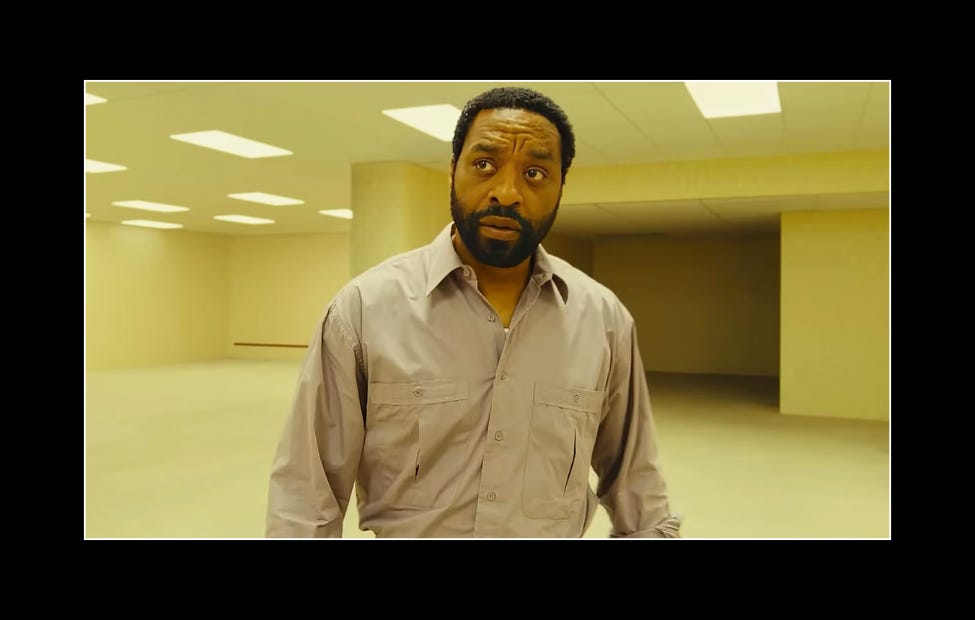
In Backrooms, memory becomes a labyrinth of guilt, resentment, and self-deception.
Now, I don’t know about you, but I have spent a lot of time looking in the rearview mirror at the good and the bad of my life. Thankfully, wise people have reminded me that you cannot live your life staring backward. At some point, you have to look forward. That is the real struggle in Backrooms: what happens when the past becomes the place you would rather stay even when it seems like a nightmare?
Movie Verdict: Love it!
SPOILERS REVIEW
While it is most certainly a horror movie, Backrooms is also interested in what and where people hide from themselves rather than what scares them or us, for that matter.
Directed by Kane Parsons, it’s a tense mix of traditional third-person and ‘hidden footage’ style camera work that bounces from ‘real life’ to a memory palace that is a bleak, old, abandoned office space. Confusion is magnified by wandering through one unsettling, endless labyrinth of hallways, rooms, pools, and impossible spaces. It’s a chilling horror movie.
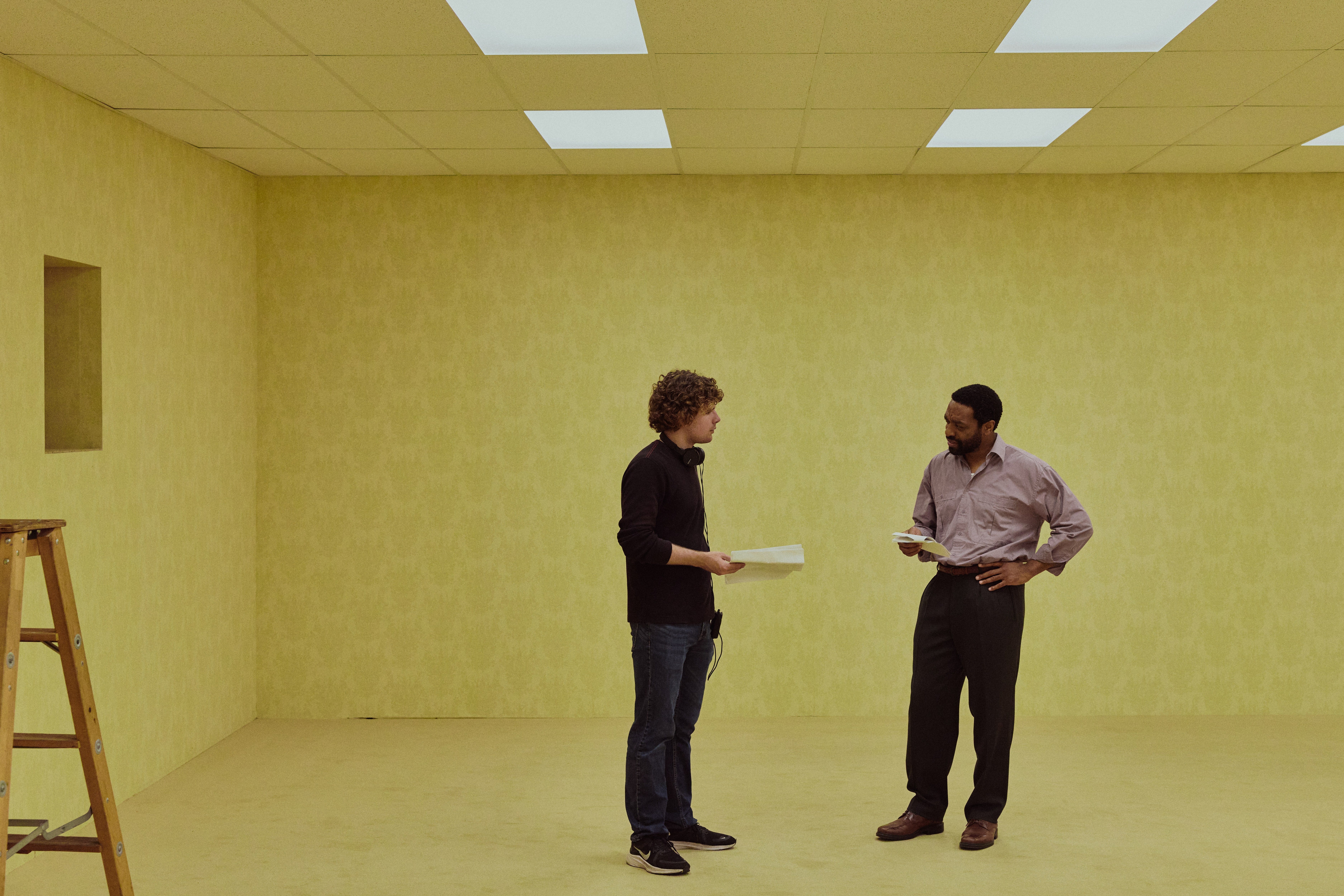
After a quick, first-person, found-footage, terrifying opening scene, Backrooms follows Clark (Ejiofor), a struggling furniture store owner whose life borders on pathetic. We meet Clark as he is shooting a pretty pathetic knockoff commercial for his business. Later in therapy, we learn his life has fallen apart. We learn he drinks too much. He has rage issues. He is an underachiever. An architect by training, he is selling particleboard crap in an enormous, underfilled warehouse. The cherry on the mud-pie of his life, his wife kicked him out.
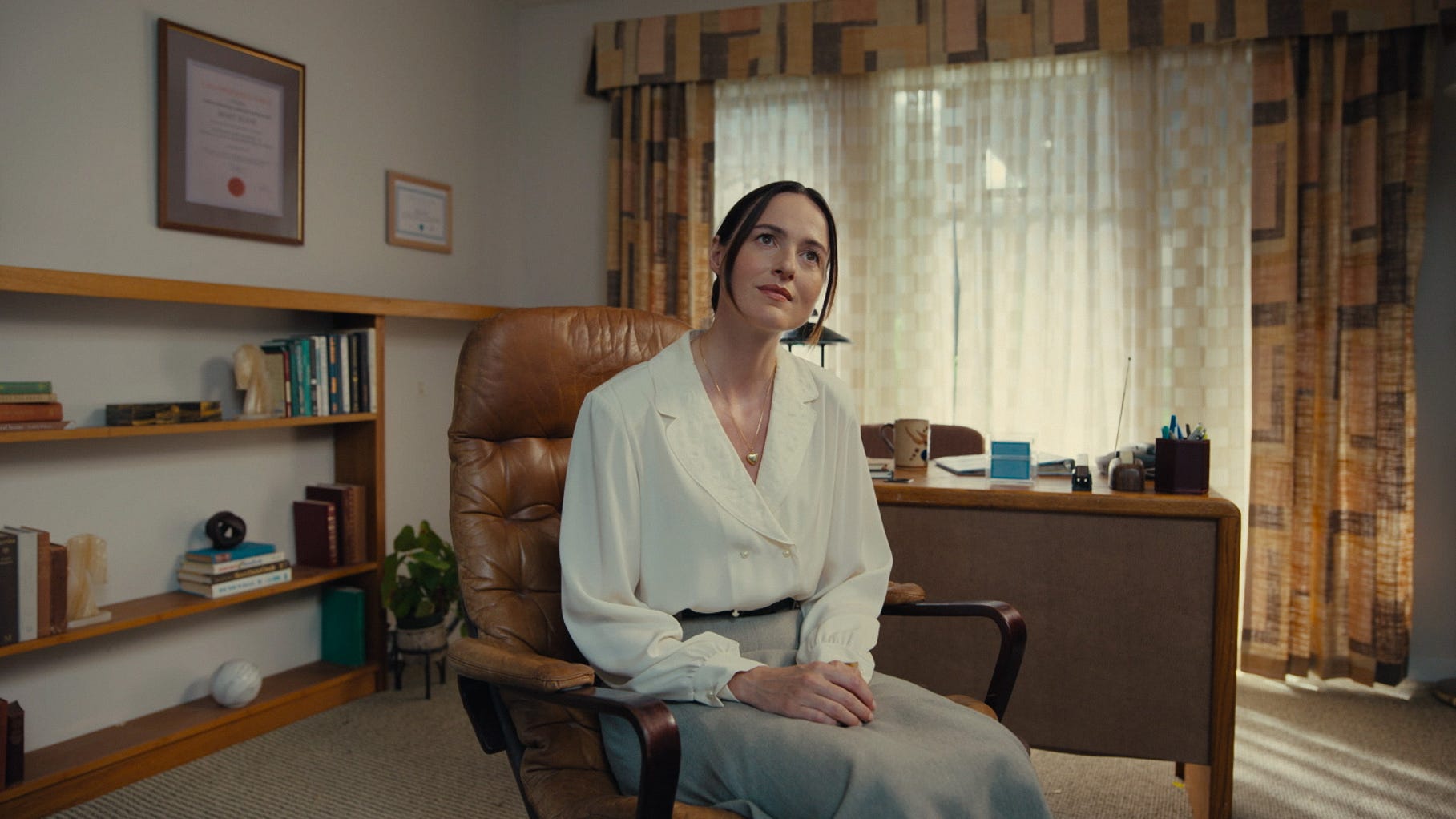
The scenes between Ejiofor and Reinsve are riveting. Mary (Reinsve) is working with Clark to gain perspective, release his anger and resentment to improve his life. She is not achieving her objective. There is a power scene in which she role-plays as his wife, and it’s quite terrifying. We see what Clark has brewing just under the surface.
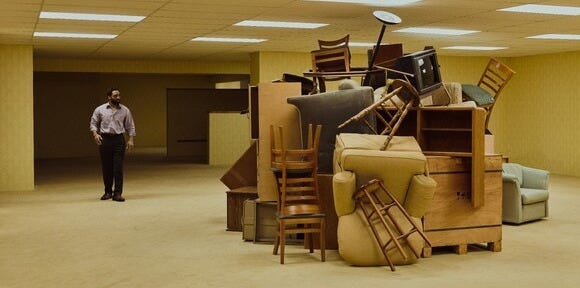
When a strange doorway appears in the basement of his furniture showroom, he discovers the backrooms, an endless, disorienting space of rooms, hallways, and passages. At first, the place terrifies him, but the more time he spends there, the more attached he becomes.
Clark eventually tells his therapist, Mary, about what he has found. She is skeptical at first, but she gets pulled into the mystery as the Backrooms reveal themselves to be not only a physical place but a space connected to memory, guilt, resentment, and the parts of our mind.
A lot of people are talking about Backrooms because of the numbers. Made for a reported $10 million, the film crossed $100 million worldwide in its opening weekend and has already earned more than $210 million globally. Those are remarkable numbers, but they didn’t surprise me. My production company, Killer Shot Films, was founded on a simple belief: give audiences a good horror movie and they will show up.
So when I bought my ticket, a week after it opened, I wasn’t interested in the box office story. I wanted to know if the movie itself was any good. Having never watched the original YouTube videos, I went in cold and was surprised to find a much more ambitious film than I expected. Inspired by Kane Parsons’ viral series and written by Roberto Patino, Backrooms becomes a complicated story about memory, guilt, resentment, and the ways we disappear into our own minds to escape reality. It also asks what happens if a therapist follows after them, trying to save them. I think!
I say that because Backrooms can be interpreted a dozen different ways. An alternate dimension. A subconscious landscape. A graveyard for places and people that have been lost to time. Or memory. Our forgotten fantasies. The film never forces a single answer.
What interested me most was that these ‘backrooms’ are built from memory itself.
Throughout the film, there is a recurring discussion about neurological pathways, the mental shortcuts people create to navigate everyday life. Those pathways help us function, but they can also trap us in patterns. We repeat the same stories, the same mistakes, and the same grievances until they become part of our identity.
No character embodies that more than Clark.
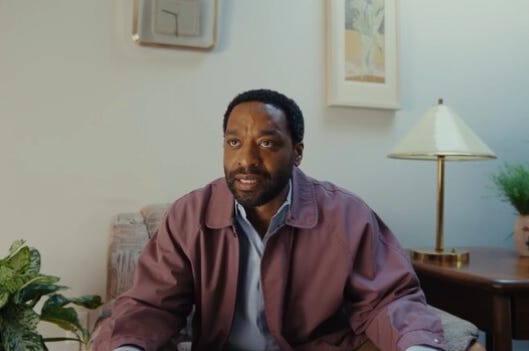
Chiwetel Ejiofor gives the film’s strongest performance as a man who has become stuck in his past. I would call him an alcoholic who blames others for the state of his life and remains fixated on a past he cannot change. Clark is angry, resentful, embarrassed by his life, and invested in the idea that everyone else is responsible for where he ended up. What makes Clark fascinating is that he doesn’t simply get lost in the Backrooms. He wants to stay.
I think Clark gets comfortable there because he is already living in the past. And the longer he is there, the more he wanders and uncovers, the more rooms are scattered with distorted remnants of memories and equally twisted and distorted people…including Clark himself.
Clark is not simply sad or lost. He is rageful, both explosive and simmering, and it’s a constant undercurrent. It shows up at work and a few times during therapy. But in the “backroom”, his shadow self manifests as his monster. It’s his lower self. An enormous, monstrous version of him, the movie has turned his inner life into something out of a night terror. It feels like the part of Clark that has been growing in the dark, fed by blame, drinking, denial, and the stories he keeps telling himself.
The rage matters because by the time Clark comes face to face with himself, it’s a creature. A huge puppet, quite scary “cover your eyes” version of Clark. But by the time Mary meets him, Clark has gotten used to being in “the backroom” and believes he is better off there, trying to live with his ‘rage creature.’
Chiwetel Ejiofor’s performance is unsettling and powerful.
I also could not ignore the casting. Clark could have been played by anyone, but he is played by a Black man, and that changes the meaning behind the anger of the character for me. He is angry, volatile, resentful, and eventually frightening to the people around him. Some of that is the point of the story, but it also brushes up against the old “angry Black man” trope in a way I am not sure the film fully examines. Watching Clark spiral, especially in scenes where his rage is directed toward a white woman, made me wonder what the movie understood about that image and what it simply used for tension.
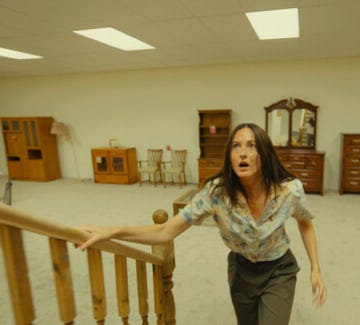
Mary’s journey is different. She is not trying to disappear into memory. She is trying to get free from it. Free from her mother’s mental illness and abuse and her powerlessness over it all. It’s an effective counterpoint.
Where Clark is trapped by resentment, Mary is trapped by guilt. She is a therapist who claims to have answers, but also knows she can help no one.
Both characters are haunted by the past, but in very different ways. One refuses to take responsibility for it. The other struggles to forgive herself for it. Their journeys through the Backrooms become reflections of those opposing emotional states.
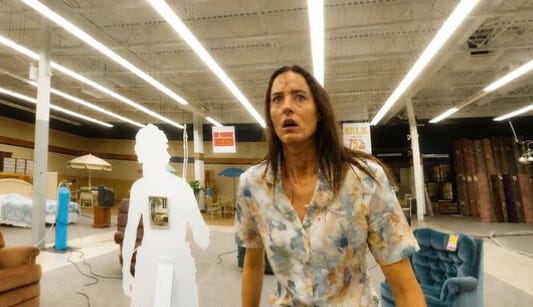
I also appreciated the film’s restraint. Parsons leaves significant questions unanswered. The Backrooms remain mysterious. Their rules remain uncertain. The film trusts the audience to sit with ambiguity rather than explaining every detail.
I left Backrooms thinking less about the maze or the monster. I was more self-reflective of my relationship with memories. I understood how they can be comforting. It can be nostalgic. It can even feel safer than the present. But here it’s shown as a place of self-deception where you can get lost with monsters of your own making.
The movie “Backrooms” is frightening for classic reasons: jump scares, found footage, small spaces, running, being chased, what’s around that corner, and who or what’s over there! I’m not going to lie; I covered my eyes more than once. But what is more frightening and equally interesting to me is the idea of being trapped by your desire to stay in the past.
The movie also leaves room for these backrooms to be more than a psychological space.
There are scientists and researchers orbiting the story, people connected to an institute that seems to have stumbled into something they cannot fully understand. I liked that layer because it keeps the film from becoming too neat.
Maybe the Backrooms are memory. Maybe they are the subconscious. Maybe they are an alternate dimension that someone found by accident and then tried to study. The movie is smart enough not to force one answer.