


Bell Hooks argued in her essay on “The Oppositional Gaze: Black Female Spectators” (1993) that Black women’s gaze has often been politicized as contextualized within the cinematic medium: “With the possible exception of early race movies, black female spectators have had to develop looking relations within a cinematic context that constructs our presence as absence, that denies the ‘body’ of the black female so as to perpetuate white supremacy and with it a phallocentric spectatorship where the woman to be looked at and desired is ‘white’” (118).
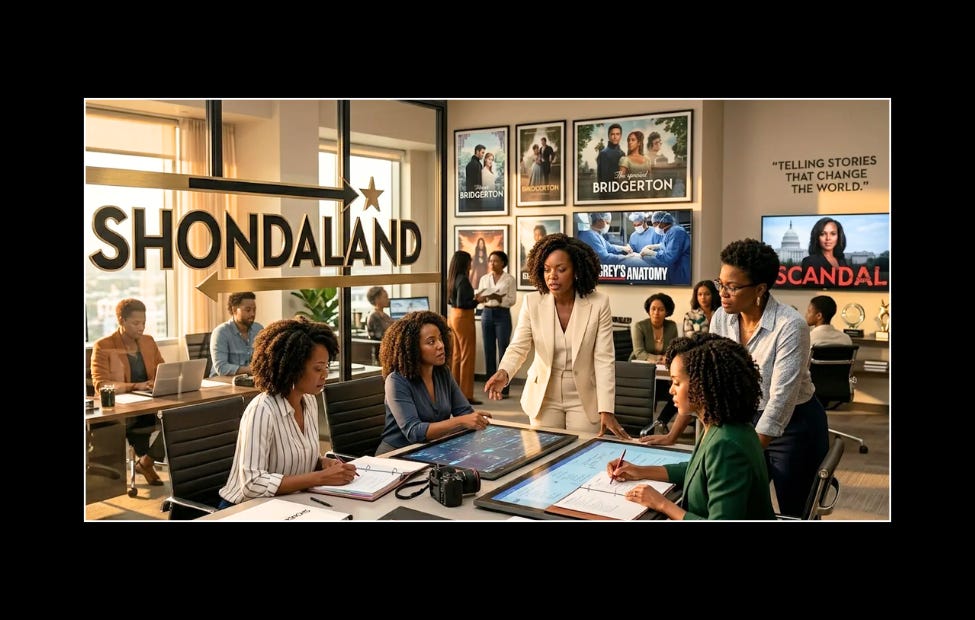
In contrast to Laura Mulvey’s feminist theory, where the subjects of the male gaze are white beauty standards and ideals—Hooks emphasizes the lack of intersectionality in film and television realms. In response, Shonda Rhimes has used her platform to bring race, gender, and sexuality to the forefront of the conversation. She is aware of her role as television creator and producer, and as a pioneer of diverse female representation. Rhimes has in fact redefined the archaic connotation of “mainstream” television through means of Emmy Award-winning series’ such as: Grey’s Anatomy (2005-), How to Get Away with Murder (2014-2020) and Scandal (2012-2018).
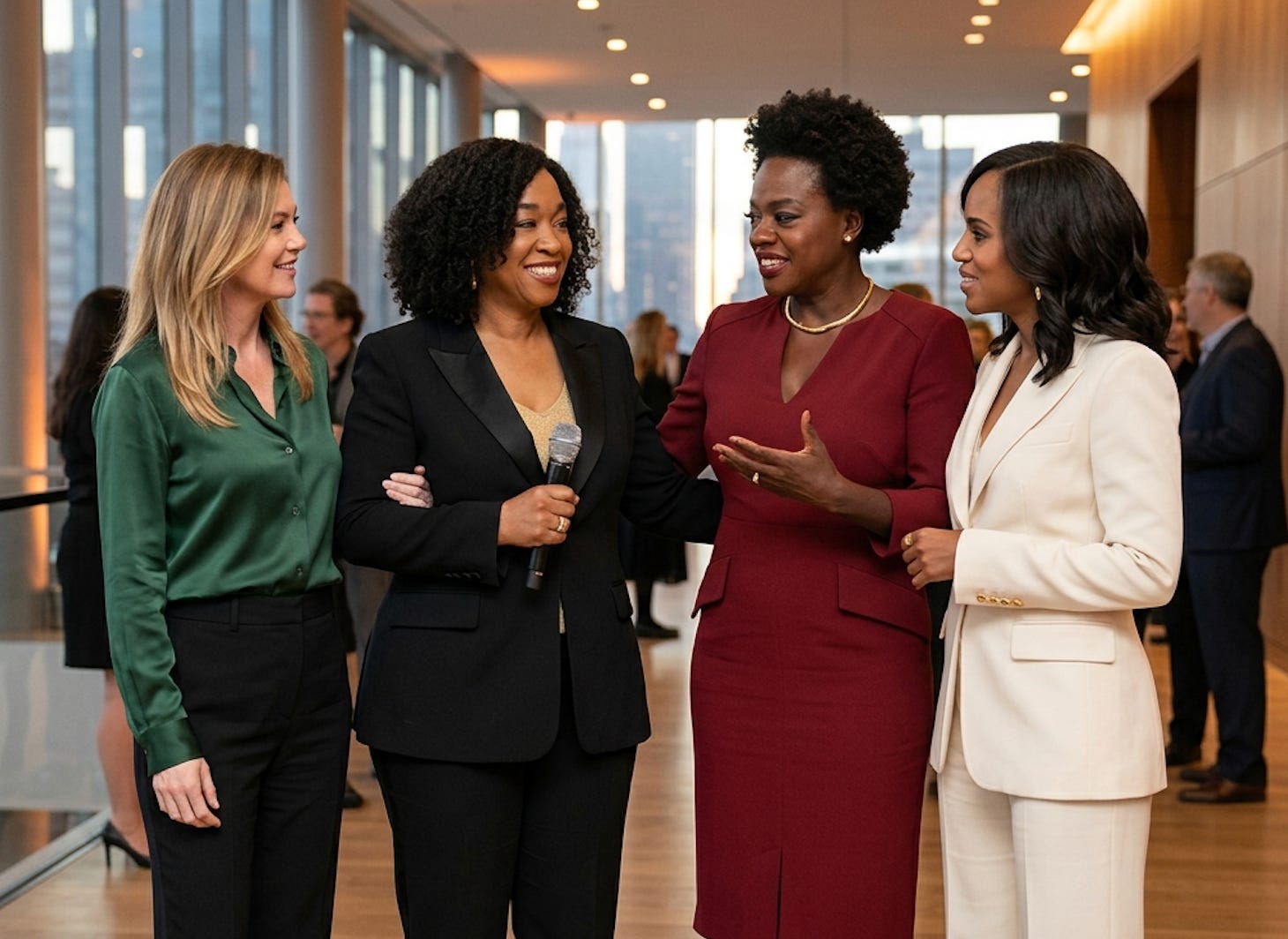
Shonda Rhimes has influenced the landscape of modern television through intersectional representation, agency, and strategic change. We saw agency and authenticity in How to Get Away with Murder’s Annalise Keating (Viola Davis), we witnessed Scandal’s Olivia Pope’s (Kerry Washington) courageous fight for systemic change, and we felt the pain, heartache, and rejoicing of Grey’s Anatomy’s Meredith Grey (Ellen Pompeo). From the early 2000s to now, we have experienced Rhimes strategically establish a name for herself through film, television, and beyond.
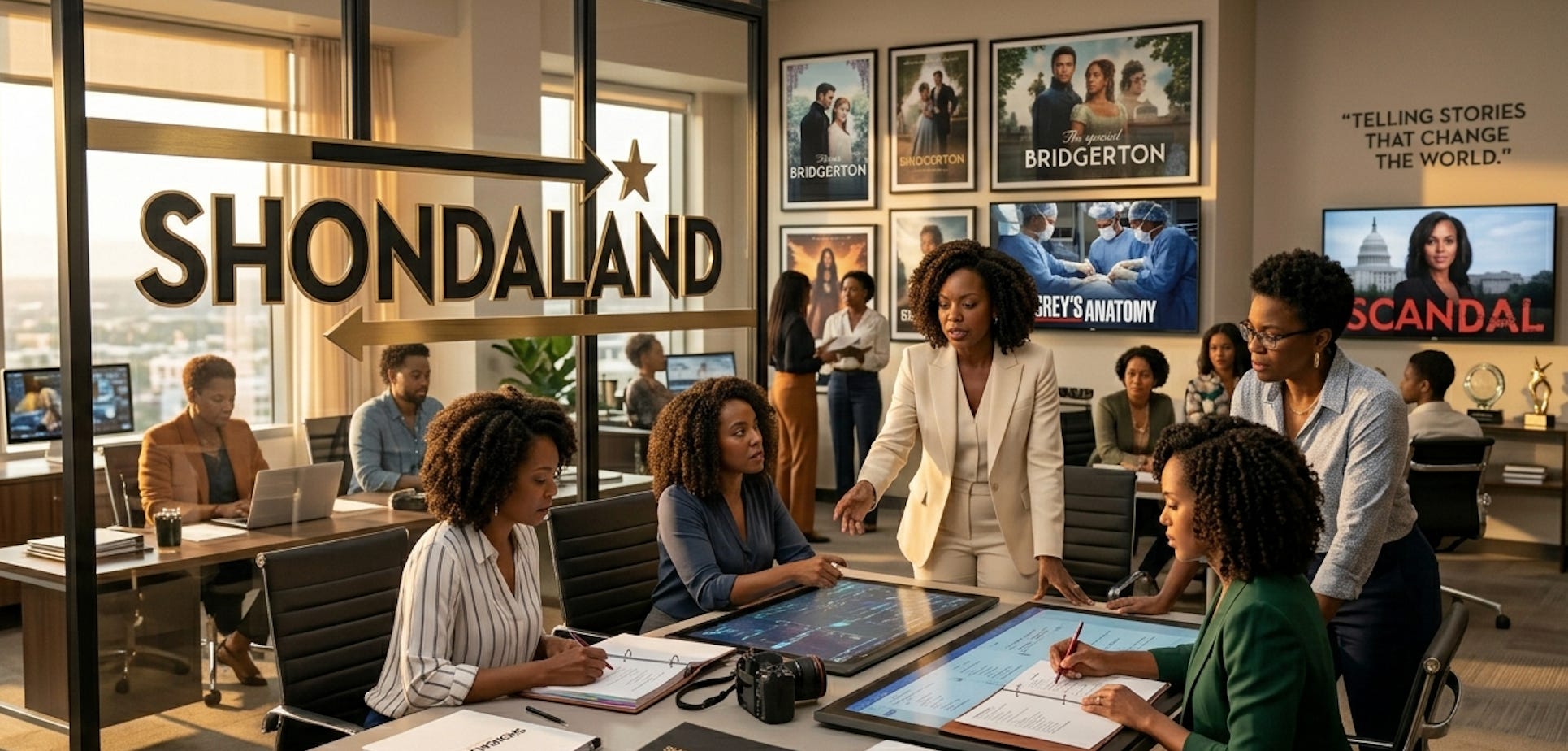
And while Rhimes has accumulated affluence through a variety of prominent productions, such as Netflix and Shondaland’s Bridgerton (2020-)—she is most recognizable for her early twenty-first century mark on the American Broadcasting Company (ABC).
Like many television writers, producers and enthusiasts, Rhimes became introduced to the world of television through the lens of film. Rhimes grew up the youngest of six children in Chicago, Illinois to her father, Ilee Rhimes Jr. and her mother, Professor Vera Rhimes. As a daughter of educators, she was passed down the gift of writing and creating one’s own voice.
After graduating from Marion Catholic High School she went on to attend Dartmouth College—where she flourished in her passion for English literature and Film and Media Studies. She began her craft of screenwriting throughout her graduate studies at the University of Southern California’s (USC) School of Cinematic Arts. Rhimes excelled, so much so, that she was offered an internship by Martin Chase Productions. Through her connection to Debra Martin Chase—the first Black female producer with a film grossing over $100 million—Rhimes worked on a multiplicity of biographies and films such as: Halle Berry’s Introducing Dorothy Dandridge (1999) Crossroads (2001) and The Princess Diaries 2: Royal Engagement (2004). Afterwards, Rhimes established independence with her debut hit series: Greys Anatomy (2005-). Nonetheless, Chase and Rhimes’ relationship is a prime example of the longevity of Black female sisterhood and mentorship within the industry.
It is evident that Rhimes’ productions are key examples of intersectionality. Ms. Kimberlé Crenshaw notably coined the terminology and theory of “intersectionality” almost three decades prior in 1989. It applies to the overlap in discriminatory practices used against marginalized groups on a systemic, institutional or individual level. Shondaland has notoriously produced shows that depict BIPOC and queer voices as authentic, nuanced characters.
Meredith Grey became the protagonist that inherently led to Rhimes’ industry and network footprint. Although Meredith Grey is relatable, problematic and complex in her familial estrangement and her work ethic—it is the environment of Seattle Grace hospital that maintains viewers’ attention and intrigue. As a female surgical intern, Meredith must break the glass ceiling alongside her fellow employees. The show illustrates how socio-economic class, disabilities, race, ethnicity, gender and sexual orientation play a role in the steamy, drama enthused workplace environment of a Seattle, Washington hospital.
During the series peak success, came another, but very distinct workplace drama. From the time it aired, ABC’s Scandal spread like wildfire when the political drama illustrated a Black female lawyer and White House Correspondent as its leading romance. Kerry Washington’s Olivia Pope played the role of “the other woman” who is in love with President Fitzgerald Grant (Tony Goldwyn). However, Rhimes shows she is so much more than that. Pope is really a “fixer-upper” who strays the lines between morality and immorality from a case by case basis.
While some might argue that Rhimes leans more towards “respectability politics,” writer Ralina L. Joseph articulates that “strategic ambiguity” as a strategy towards more inclusive, widespread representation. Grey’s Anatomy is not only focused on sexism, it is about relationships and humanity. Racism, homophobia, and the hyper-sexualization of Black women is a part of Scandal, but the focus is on the complexity of Olivia and Fitz’ dynamic. How to Get Away With Murder is not centered on Keating’s identity as a Black queer woman, but there are intimate, vulnerable moments where we—as the spectator—see how these characteristics show up emotionally, mentally, and socially for her in the outside world.
Rhimes reimagines a future where Black women take agency over their bodies and minds. As Joseph reiterates in reference to the Black women of Shondaland: “Race functions as but one of many personality traits in Shondaland.” Evidently, Rhimes’ shows are understandable because they bring underrepresented identities to the forefront of national and worldwide television. Her shows do not depict Black women in subservient roles or the prejudicial “Mammy” figures. They in fact defy all those derogatory images of blackness that are projected onto Black women in authority.
Rhimes’ impact is not only a desire for the future of Hollywood, it is a necessity. Her design and creation of characters triggers an emotional reaction in order for viewers to empathize with such captivating women who’ve been hurt, exploited and broken: “Olivia and Annalise are indeed angry in some ways; as women of color trying to hold power in white-male-dominated fields, they would and should be, but they’re more than angry. Indeed, none of the major players on Rhimes’s dramas are defined by one emotion or trait. They are all mere facets of Rhimes’s vision” (Joseph). Therefore, while Rhimes’ vision is intentionally structured to illustrate real humanity and morality through the values of Meredith Grey, Olivia Pope and Annalise Keating—she prioritizes intersectional identities on-screen.
Through Shondaland’s partnership with Netflix and ABC, Rhimes has been able to secure a platform for Black, Indigenous, and queer people of color. Representation not only ingrains positive self-assurance from a young age, but develops a sense of empowerment and belonging.

It may even be inferred that Rhimes draws from Hooks’ theories to take back the Black female gaze once and for all.
—Savanna Mai
Sources
Shonda Rhimes | Producer, Writer, Actress – IMDb
Shondaland.com
The Racial Logic of Grey’s Anatomy: Shonda Rhimes and Her “Post-Civil Rights, Post-Feminist” Series – Warner, K. J. (2015), Television & New Media.
“I Am the Highest Paid Showrunner in Television!” Shonda Rhimes’ Work and Influence in the Media Industry – Mbinjama, A., Nkoala, S. (2024).
Strategically Ambiguous Shonda Rhimes: Respectability Politics of a Black Woman Showrunner – Joseph, R. L. (2016), Souls.
The Symbol of Hair in ABC’s How to Get Away With Murder – Salzburg, M. (2018), Satura.
The Year in Shonda Rhimes; What can’t she do? – Seitz, Matt Zoller (2014), New York Magazine.