


Opening Remarks:
In an age of cinema that is inherently defined by modern technology, I find myself referencing the past more with each day. Whether it is a collection of poetry, a painting, or a film, my mind is continuously confronted with the question: Is everything a sample of another? And if that is so, does intertextuality apply to the entirety of cinema?
Intertextuality was popularized by Bulgarian-French philosopher and professor, Julia Kristeva. She had studied Russian philosopher Mikhail Bakhtin—whose theories inspired her own. The concept of “intertextuality” is defined by the repetition of concepts, ideas, and characteristics within literature. As a byproduct, film, media, and visual arts are inherently connected due to societal, cultural, and political influences.
As a filmmaker, much of our work stems from those who came before us. However, this does not mean our storytelling lacks originality. It simply means we are human. The idea is to take familiar themes, experiences and place them in a new environment—whether through genre, world-building, or structure. The same themes existed back then, exist now only in a modern way. Take Jordan Peele’s Get Out (2017) for example: the foundation of the film is based on Sidney Poitier’s Guess Who’s Coming to Dinner (1967).
Black artists have a diverse diaspora of narratives, while also being able to relate on an intrinsic level. This is why I pay homage to the filmmakers, writers, and artists who have revolutionized my journey.
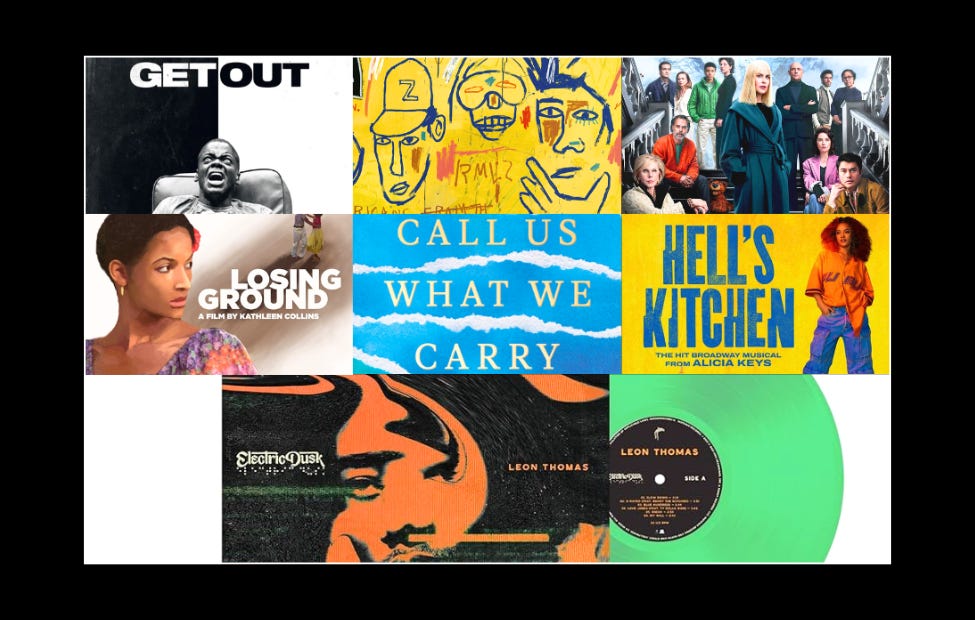
The key to unlocking writer’s block? Write down a detailed explanation—or commentary, if you will—on people or pieces that have influenced, inspired, or impacted you in one manner or another. Here are my top seven influences and my thoughts:
My Artistic Analysis Behind The Influences That Have Shaped Me
1. It is impossible to say in a few words what this piece means to me. In the moments watching Get Out (2017) with my dad, we reached a consensus: filmmaking was no longer a hobby for me—it was my waking world. I would spend the years post-that moment waking, breathing, and consuming film and television. Specifically, I became unearthed by the genre of Black speculative fiction through the lens of horror. No other film has had this impact on me as a viewer, an artist, and a creative. Peele took his idea from page to screen and received an Academy Award for Best Original Screenplay. Every chance I got to digest this film, I did. I explored the “Sunken Place” and its representation of Black life in America due to systemic oppression. I reviewed Get Out theories on YouTube and watched interviews with Jordan Peele himself. I had never seen a film so intentional with its usage of symbolism, and I knew from then on, I wanted to do that. To say this film has influenced me is an understatement. It is the reason I switched my major to Film and Media in undergrad and ultimately, the reason I am where I am now. In a world of mass consumption and oversaturation in film, television, and media, Peele reminds us that Black creatives constantly provide original concepts inspired by the past works of our ancestors. He also taught me that a critical part of cinema is screenwriting. From then on, I became motivated to write, direct and develop Black narratives through the lens of magical realism. Peele drew on tokenism, fetishization, and metaphysical violence of the Black body within the film’s span of 1 hour 44 minutes. He knew the impact he could have on his audience and he took the chance. He opened the door for me to do the same.
2. Jean-Michel Basquiat’s Hollywood Africans (1983) rejects caricatures projected onto Black actors and actresses within the twentieth century. Stereotypes like “gangsterism” infiltrated the film industry like wildfire. Basquiat, like many Black artists, boycotted this notion. I am one of these artists who rejects the notion of representation through stereotyping. I take what I have learned from Basquiat and I apply it to my films and visual art. Like Basquiat, I think the media has more power than many realize. I choose to represent authentic Black characters outside of a monolith.
3. Nine Perfect Strangers (2021), by David E. Kelley, John-Henry Butterworth and Samantha Strauss, is a beautiful television series. Every person is dealing with a form of grief, whether they have lost themselves, a loved one, or their purpose, they have come to the same retreat seeking answers. This series moved me more than I knew. I saw a piece of myself in each character: from the writer who lost her vision, to the woman dealing with heartbreak to the wife who finds validation from social media. Not only were these characters diverse in looks, image and ethnic backgrounds, they felt real. They grew together as we, the spectators, grew with them. The series reminded me that film and literature are interconnected. Furthermore, Nine Perfect Strangers influenced me to ground my projects in the humanity of the characters. After all, stories cannot exist without the voices behind them.
4. I first watched Losing Ground (1982) in my Feminist Film Theory course at Columbia University. Kathleen Collins created the film to portray the nuances of a Black couple. While they are not perfect—they are not caricatures. They are human. They are a successful couple who have outgrown each other. Sara (Seret Scott) is a beautiful, Black intellectual. She is a professor who explored acting and academia. Her husband, Victor (Bill Gunn), is an artist whose muse is entirely women. As a result, his uncontrollable lust leads to infidelity. In contrast, Sara appreciates Victor’s art, but he seldom supports her dreams and goals. As a woman of intellect, she desires to become more than a statue for Victor’s gratification.
Through the storyline, the characters showcase a diverse range of emotions. While the love is inevitably there, Victor’s desire for external validation becomes the catalyst for Sara’s independence. Sara ultimately finds joy and self-assurance as the lead actress in her student’s film. The agency she demands through this role is what inspired my own short films, René (2025) and Back-and-Forth (2023)—two films exploring Black relationships.
5. In short, Call Us What We Carry (2021) inspired my own healing journey through which I wrote poetry about loss and love. Amanda Gorman reminds readers that the only way to surpass pain is to confront it. It is through my poetry that I find ideas for my films. It is true that all art is reflective of one another.
6. Hell’s Kitchen (musical) by Alicia Keys and Kristoffer Diaz is a semi-autobiographical musical based on Alicia’s upbringing in Hell’s Kitchen, New York City. From the soundtrack to the choreography, I was moved to tears by the ensemble’s performance. My mother is often a source of my own art, whether visual arts or poetry. As a biracial girl like Alicia Keys, I looked up to her as a mentor more than just an artist. I saw myself in her. I valued her courage in sharing her upbringing with the outside world. She told her story through music, while I tell mine through film.
7. Electric Dusk (2023) by Leon Thomas is an album that has brought me peace. When I write, I often turn to R&B and Neo-Soul to find tranquility. Treasure in the Hills is a song that reminds me of heaven. It is no mistake that this album came out the same year I began directing. While I did not listen to Leon’s work until last year, his song instills a feeling of calmness that washes over me. When I listen, I ponder an endless sunset, the ocean and home. When I screenwrite and direct, I experience similar imagery.
Closing Remarks:
Ultimately, I am a culmination of the above influences. I am grateful for their existence because they have taught me to be grateful for my own. Intertextuality has existed in everything we see, touch, or marvel in. Only now, it has expanded. In a world of remakes and replicas, the sequel is never like the original. By sharing these influences, my goal is to inspire your personal self-reflection of these works—or to write down your own list. By examining those who embolden us, we can pave pathways for each generation. You just have to be willing to look into the past, present, and future.
Source:
Julia Kristeva: Intertextuality – Literary Theory and Criticism