


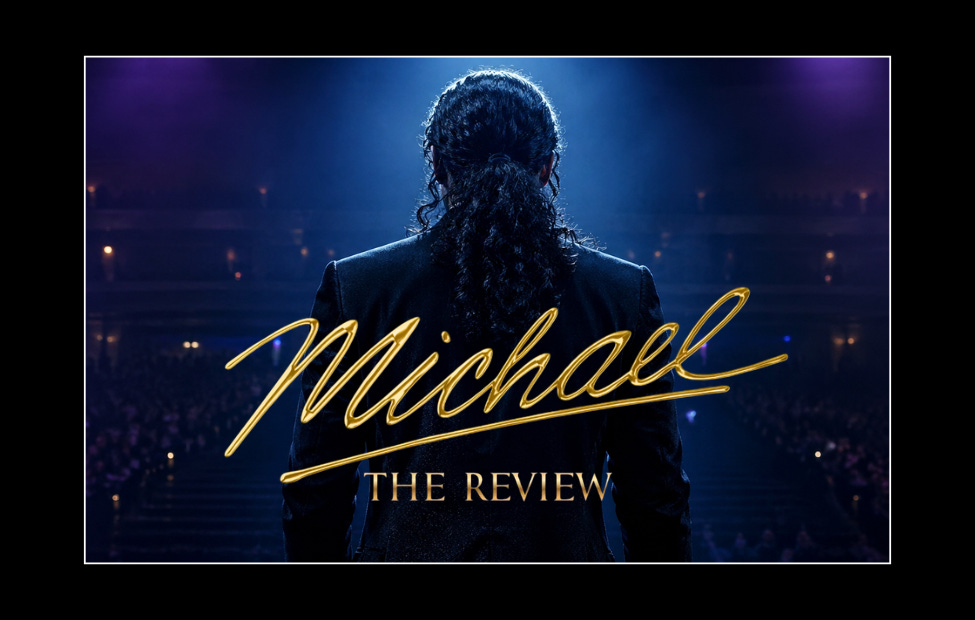
Michael is a moving, imperfect, and deeply watchable film that reminded me why Michael Jackson’s music still reaches across generations.
Directed by Antoine Fuqua and starring Jaafar Jackson as Michael Jackson, with Colman Domingo, Nia Long, Miles Teller, Laura Harrier, Kat Graham, Larenz Tate, Jessica Sula, KeiLyn Durrel Jones, and Kendrick Sampson, Michael is a film wrestling with genius, family, trauma, spectacle, and the impossible task of telling a story about a complicated life.
Before I get into Michael, let me say this: I am not here to hand down final verdicts. I am here as one person who loves movies, has studied them, worked around them, and talked about them for decades.
I write about culture, marketing, and media on my Substack, Let’s Talk About It. I co-host a film and streaming podcast, The Watchers, with Kevin Marable, the founder of TheBlkScript Network. Now I’m adding even more to the conversation by writing reviews here on Blkscript.com.
Please also feel free to share your perspective in the comments. It’s okay to have different feelings about movies.
Another note: if I watch it, I am always rooting for it to win, for it to work.
Now that all that is out of the way, let’s talk about it.
Michael comes in hot with “Wanna Be Startin’ Somethin’” from the Thriller album. You are immediately transported back to 1982.
The music and his songs are beautifully represented, but I was never really worried that the music would be the problem. I was more concerned about how they would tell his life story. Would it feel like a trial, an explanation, or a condemnation? Maybe some people wanted that. I did not.
The musical numbers really show you something about Michael’s talent. Of course, we already knew he was talented. That is not new. But the movie shows his creativity in a different light. It shows how much he wanted to push music beyond one lane, making it multi-layered storytelling, a real spectacle, and a movement all at once.
Thriller was my favorite musical sequence because it showed that creative ambition so clearly. It reminded you that Michael was not only performing songs. He was building worlds around them.
The film could have gone deeper into his creative process, songwriting, the music industry, his creative choices, and how he ran his concerts, sessions, or rehearsals. Did he become the taskmaster? I would have loved to see more of his process. Instead, it was montages. Beautiful ones, all the same.
I also would have loved a more realistic portrayal of the music industry. As A Tribe Called Quest famously said, “Rule 4080, record company people are shady.” That would have been interesting to dig into more. Instead, the record executives were some of his biggest champions.
The movie went more down the lane of music, performance, family trauma, and Michael’s rise to stardom amid dysfunction.
His abuse, his hoarding of animals, his obsession with Peter Pan, and his desire to stay childlike are told pretty simplistically. Quite matter-of-factly. I wanted more depth there, but I also understand that this movie is not trying to become a full psychological excavation of Michael Jackson. It gives us pieces. Some of them work better than others.
The portrayals of the family left me in real discomfort.
In my opinion, the movie sets up both his parents as villains.
Colman Domingo’s Joe Jackson is complex, disturbing, and difficult to watch. He is an abusive father with a serious intent to make his children more than he was. Abusive, yes. But also, in the film’s portrayal, someone who never has a come-to-Jesus moment. Someone who possibly thought he was protecting his sons by pushing them into success. That is what makes it so uncomfortable.
We have seen versions of this kind of character, a Black father figure, before, like King Richard. A parent who sees something in a child pushes the child toward greatness, and here, the father crosses the line. He is a terror. It is hard to watch.
Domingo’s Joe Jackson is a complex, deeply flawed, violent, and angry man, only slightly presenting ambition and drive through the mask of lifting his children out of poverty. But right underneath are the narcissism, jealousy, and hate.
The film shows that Joe’s wrath was focused on Michael. But we don’t know if that’s true. We do not fully know from this movie whether he abused the other children in the same way, but we definitely see that Michael becomes the target of his cruelty. On the whole, Joe Jackson gets the closest thing to a villain arc, a consequence for his actions. He pushes them to success, and then he is pushed out.
Nia Long’s portrayal of Katherine Jackson was layered. She was an unsympathetic character to me because I could not understand how a mother watches her husband beat her children and does nothing. That is hard for me.
The film bounces between showing her as this strong mother who eventually stands up for Michael, but it felt a little too late. You don’t see any apparent reason she ignores the abuse. Are we supposed to believe that is just what Black mothers do? No. I needed to know her reasons for not protecting Michael or leaving Joe. And when she finally steps in and protects Michael, it feels like a third-act action as opposed to something driven by character. Nia does give the character depth. I could see the fear, the faith, the survival, the denial, and the limitation of her fortitude and strength. I think I understood what the film wanted me to feel. I just could not fully get past what she allowed.
The movie is a bit top-heavy: a lot of setup, a wide story, and not enough depth.
For example, I wanted more of the brothers. I wanted more of LaToya. I wanted more of Janet. I understand Janet did not want to be a part of it. That is unfortunate because more dynamics between the family members would have given us more heart and more understanding.
Jaafar Jackson’s performance is transcendent. There were times when I forgot I was not watching the real person, and that is what a movie is supposed to do. It is supposed to take you somewhere. It is supposed to suspend your disbelief.
He captures the movement, the posture, the voice, the softness, the stage presence, and the way Michael seemed to exist in his own weather system.
We witnessed the results of his trauma. We saw many times that even after being rich enough to leave, Michael stayed. The movie assumed we would understand that the repercussions of his abuse would be a trauma bond that mixed love, guilt, and hate.
You really get a sense of Michael’s isolation as a result of being famous from such a young age. He was surrounded by people, but still alone, left to play with his pets to replace real friendships.
Another aspect that would have been interesting to see more of was the celebrities and the high-net-worth world around him. We did not see Prince. We did not see Donna Summer. We did not get the folks who would have been in his orbit. We saw a few, Quincy Jones and Don King, but really, that larger world was missing. It would have been exciting to show the world he was moving through, not just the stages he performed on.
I also would have liked to see more of his personal life. Let’s say, for example, Brooke Shields. They had a real friendship. It would have been interesting to see that brought to life. Some glimpse of real friendships. Some sense of who he was when he was not performing or creating, not with family, and not in business mode.
The supporting characters they focused on were a mixed bag. The actors were very good. For example, Miles Teller played his attorney and manager, John Branca, and he did strong work.
Billy Bray, his head of security and bodyguard, played by KeiLyn Durrel Jones, was underdeveloped as a character. I would have liked to see more of him. I understand it is hard to know what really transpired between the two of them, but the movie sets him up in a way that made me want a stronger payoff. Joe Jackson hires him and says, “Protect my son,” and then Billy protects Michael from his own father. Nice. But I would have liked to have gone deeper in the middle. That felt like a missed opportunity.
The directing was grand and big. I saw it on an IMAX screen, and this kind of story was built for that kind of scale. Montages were the main way the film moved through time, with slates indicating the year. Sometimes that worked. Sometimes it made the film feel like a string of music videos with narrative scenes in between, which affected the intimacy.
I love scenes that create private reflection, when characters are alone and obviously unaware we are watching. We get to glimpse behind the veil and see human behavior. In this movie, Michael often felt as if someone were watching. Maybe that was intentional. Maybe that is part of who Michael was, a person who had been watched since childhood and never fully knew how to stop performing. But it also kept me at a distance from him.
Let me say it again. Jaafar Jackson was brilliant. Michael was obviously channeling creativity, so much so that it feels miraculous. Jaafar captured an inspired artist in the flow. He embodied that character’s spirit so perfectly. But was there any room for complexity?
I saw Myles Frost play Michael Jackson on Broadway, and he was brilliant, too. It might have been interesting to see someone who is not related to him, someone who is not attached to a particular family legacy, play him in the film. Someone more objective might have brought a different edge, maybe a darker or messier note.
That is not a knock on Jaafar. He is extraordinary. But because he is so connected to Michael, there may be places the performance cannot go, or chooses not to go.
The Pepsi commercial accident was very hard to watch. I remember when that happened, but I do not think I ever really understood how serious it was. Watching it unfold close up again was scary.
Now, about the scandal.
This is a review of a movie about a really complicated human being. And to tell a person’s story before the major scandal of their life, it has to be told from the perspective that we do not yet know about the scandal. That is the linear aspect of being alive. People wanting the film to address it directly is complicated because, for most of the movie’s timeline, that part of the story has not happened yet.
I think the film chooses to celebrate the music and give us Michael before the public dismantling of his image. Some people will reject that choice. I understand that. But I also understand why this movie exists in the frame it chooses.
The movie's ending was an odd choice; I did not quite understand it. It ends with a slate that says more story is coming. Okay, that was a bit of a letdown.
I had an alternative idea. What if he finishes a concert, goes into a dressing room by himself, and then looks at himself in the mirror?
Cue “Man in the Mirror” underneath.
Fade to black.
That may not be perfect either, but it’s better than just a slate. It would have given us reflection. It would have let us sit with him. It would have connected the public performance to the private human being. I would have liked that.
Final thoughts: this movie allowed me to hear and experience his music again, this time with a crowd. I was happy. That made it worth every minute. I think people are going to go see this movie because, as the character says, music crosses boundaries and lines.
The movie is flawed. It is top-heavy. It skips things I wanted to see. It leaves some relationships underdeveloped. It gives us spectacle when I sometimes wanted intimacy. It gives us genius when I sometimes wanted more humanity. It gives us the music industry, but not enough of it. It gives us family pain, but not always enough family texture. It peaks at Neverland. It shows isolation, animals, Peter Pan, and the desire to stay childlike, but does not fully unpack those threads.
But the musical numbers lift the film past many of its flaws.
I was reminded of what it felt like to love his music before the world around the music became more complicated.
That is the movie’s power.
Rating: Enjoyed It