


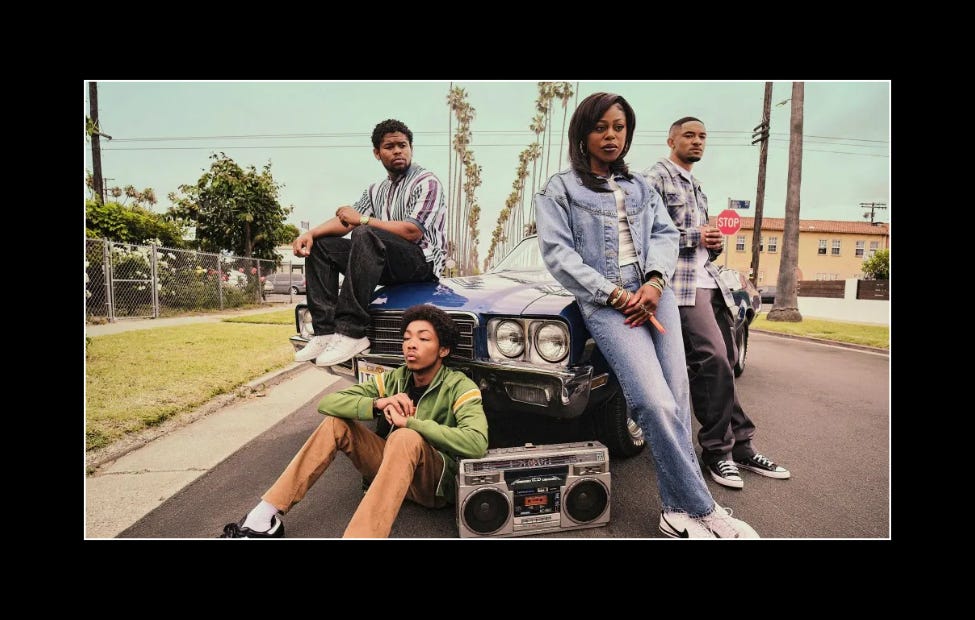
The Drop: A Snowfall Saga is a wildly visual and bold family drama about folks trying to love, protect, and believe in their dreams. It’s set in South Central Los Angeles in 1990, amid the sounds of West Coast rap, the dangers of gang violence, and a brutal police force.
The weekly series premiered September 8 on FX, opening a new chapter in the Snowfall world.
The Set Up
It’s 1990. South Central Los Angeles is still in the grip of crack, gang violence and an LAPD that was just as dangerous and violent as those streets. Bloods and Crips shape much of the geography of where a person could and could not go. West Coast rap is telling the story of all of it in real time, the anger, the fear, the swagger, the grief, the survival. The music business is starting to realize there is money to be made from a sound and a culture that Black Los Angeles already knows belongs to them.
That is the world of The Drop.
The story centers on Wanda Bell (Gail Bean), now clean, separated from Leon Simmons (Isaiah John), she is reinventing herself. While working at a used-car lot, she is focused on becoming a producer. She’s “interning” for d-boy turned producer Darryl “DG” Grant (Brandon Mychal Smith). From the top of the show we can see she can see talent, and sell anything and Wanda knows her cousin Lamar Kinsey (Asante Blackk), a young musician and producer with real talent, and believes he could be the key to working with local rapper Artillery (Simmie “Buddy” Sims III).
Lamar’s mother, Gerty Kinsey (Nicki Micheaux), and father, Big Daddy Kinsey (Mykelti Williamson), are less interested in what Lamar could become than in keeping him alive. His older brother James Kinsey (Peyton Alex Smith) understands the danger around them and is caught between protecting Lamar from it and recognizing that his little brother may actually have something special.
Leon is trying to build a different life too, working at a free legal clinic and questioning Wanda’s determination to chase a business tied to many of the same people and streets they fought to survive. Wanda sees music differently. She sees possibility. And she is not willing to let Lamar, or herself, give that up because everybody around them is afraid of what might happen.
The Review
I have to start with a confession.
One of the stars of The Drop: A Snowfall Saga, Nicki Micheaux, is a good friend of mine. So I was nervous. Because what happens if your fabulously talented friend is in a show and you don’t like the show?
Turns out I didn’t have to worry.
Within minutes of Episode 1, “Click Pop,” I forgot to be worried. I forgot I knew Nicki. I forgot I was supposed to be watching critically.
I was just in.
And here’s the other thing: I have never seen Snowfall. Not one episode.
I came into The Drop knowing absolutely nothing about this world or these characters. Wanda Bell, played by Gail Bean, and Leon Simmons, played by Isaiah John, carry over from Snowfall, but I didn’t know that while I was watching, and it didn’t matter. I resisted the urge to google and just kept saying, more will be revealed.
The Drop immediately gave me everything I needed.
I’m from NYC. Manhattan born and raised in Da Bronx. It’s for sure It was how I remember LA…how it looked and felt.
It’s 1990. South Central Los Angeles is still in the grip of crack, gang violence and a terrifying LAPD. Bloods and Crips are at war, shaping the geography of everyday life. West Coast rap is one of the hardest-hitting sounds coming through car windows and out of cassette decks, and it’s telling the stories of what is happening all around them.
Also, the record labels are watching and listening. Perched like vultures.
This show is wildly visual. It’s what first grabbed me.
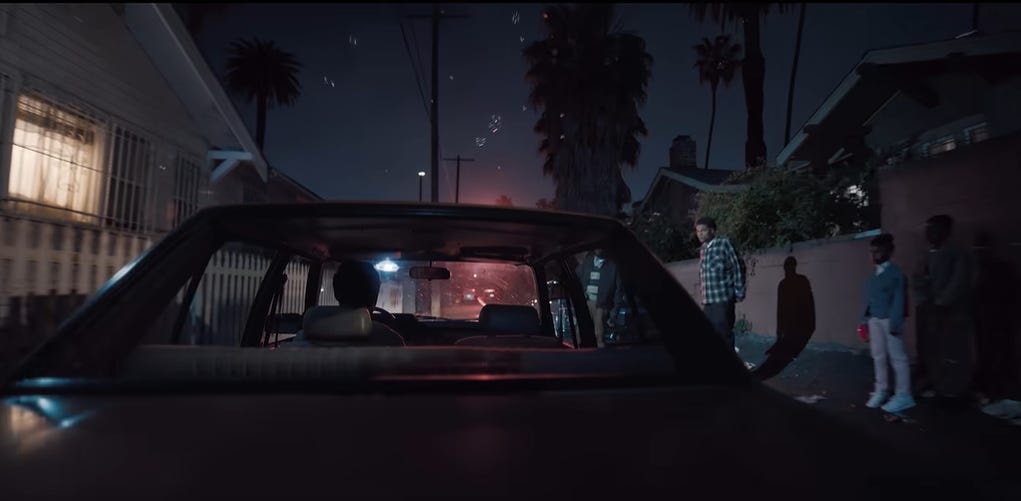
The colors are rich and saturated. The light is vibrant and sharp. The camera is constantly finding angles I didn’t expect, low angles, side angles, shots through windows and car interiors, even a shot that seemed to be looking at the characters through the guts of a car.
There is a moment after a shooting when the camera pulls away from Lamar, curled on the ground protecting his head, and then cuts into this incredible moving shot as he runs for a bus.
Director Ben Younger, the pilot's Director of Photography is Xiaolong Liu! They are really doing things here. The series DP is Christian “Tico” Herrera.
And here’s what struck me most about those images. They are also warm.
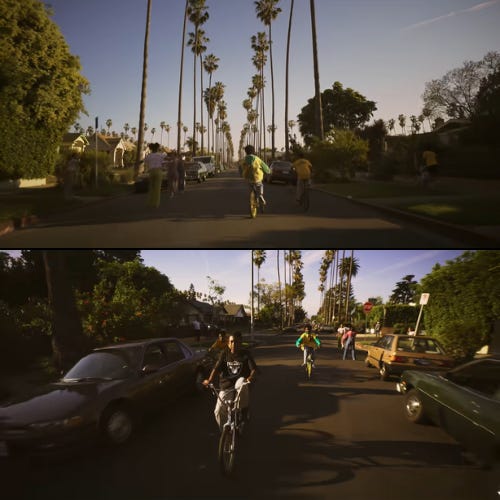
I’ve seen a lot of movies and television shows about neighborhoods in Los Angeles, in the ‘hood’ where the camera seems to have already decided how we should feel about the people who live there. The images are cold. Bleak. Dangerous.
The community becomes something to observe from a safe distance.
The Drop doesn’t feel like that.
It feels like the story is coming from inside the neighborhood.
It isn’t judging these people or explaining them to us. It understands them.
I’m from a different hood. Gun Hill Road, the Valley, the Bronx.
So while this world feels familiar to me, it’s also foreign. I didn’t grow up in Los Angeles. I didn’t live through the particular nightmare of Bloods and Crips, LAPD violence, their guns, their fear, or their constant calculation of which block you could safely walk down.
I can’t pretend to understand their experience.
But something in this story still felt familiar to me. And it felt truthful.
I remember the first time I drove through South Central and thinking, this doesn’t look anything like the way they portray it in movies and on television.
And that’s about perspective.
It’s about seeing both the love and the danger. The fear and the family. The violence and the talent. The dreams and the reality.
That perspective traveled.
It crossed the jet stream all the way to New York.
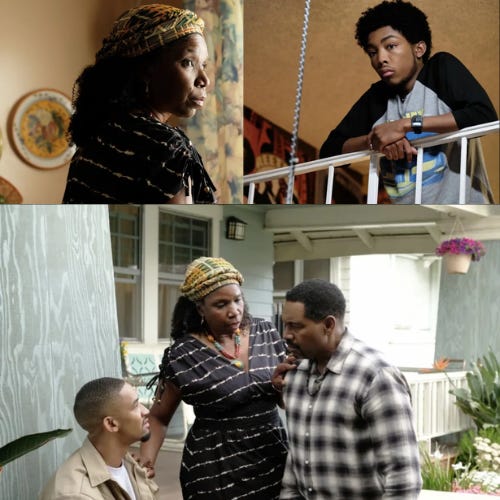
Because I understood the families trying to hold their children close. I understood the dreams that seemed too dangerous to encourage. I understood people who could see something bigger for themselves even when everything around them kept insisting they stay exactly where they were.
The Music
Music is the blood pumping through this episode. It isn’t there just to remind us that it’s 1990. It tells us who these people are, what they hear, what they want, and sometimes what they can’t say any other way. And the people behind that sound deserve their flowers. Larrance “Rance 1500” Dopson serves as executive music producer and composer, Kier Lehman is the music supervisor, and Jason “Problem” Martin wrote original lyrics and produced vocals for the series. Together, they are building music that feels specific to this place, this time and these characters, not like somebody dropped a ’90s playlist over the pictures.
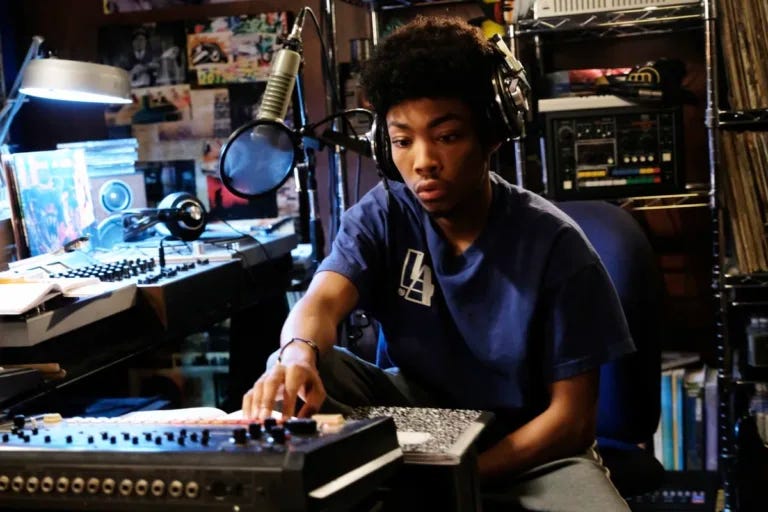
What I really loved is that the show doesn’t just tell us Wanda has an ear or that Lamar is talented. We hear it. When Wanda starts talking about looping the horns, letting the bass line cycle and making sure the funk doesn’t overpower the hip-hop, she sounds like somebody who knows exactly what she’s doing. And when Lamar drops that track and the whole room starts moving before anybody says a word, you understand immediately. The beat tells you before the dialogue does. That’s not background music. That’s storytelling.
You hear the cassette slide into the boombox. You hear the click. You watch people pass tapes around and judge a song within seconds.
Wanda is the most fascinating character and I wanted even more of her!
Gail Bean is just dead right in that role. Sheer gold.
Wanda, I figured out is clean. She is hustling at a used-car lot, “interning” for record-label owner Darryl “DG” Grant, played by Brandon Mychal Smith, chasing artists and trying to build something for herself.
And she is good.
At one point, while demanding a piece of a track she’s helping to create, she tells Darryl:
“Deep down, more than you want to fuck me, you know I got vision.”
Yes, she does.
That’s important.
She’s not just ambitious. She has an ear. Talent. She has a vision and a voice.
When Wanda and Lamar start talking music, she understands why the bass works, what the horns will do, where the funk needs to sit against the hip-hop. She understands that this belongs to Los Angeles.
She’s producing. I’m so excited to see where she will go!
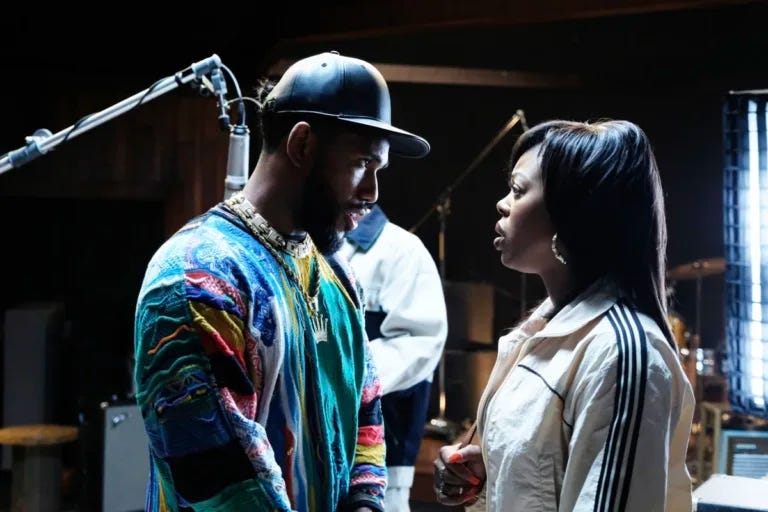
Malcolm Spellman created the series and is one of the credited writers on the premiere, along with Rance Ward and Eli Dansky.
The dialogue doesn’t sound like television characters explaining themselves to us.
Nothing felt cliché to me. Nothing felt like somebody had assembled a collection of “street” phrases and handed them to actors. The words felt connected to the people saying them. And the actors are so completely inside their bodies and inside these characters that I felt transported to another time and another place.
That includes my friend Nicki Micheaux as Gerty Kinsey.
This was my test.
Could I stop seeing Nicki?
Immediately, I saw Gerty.
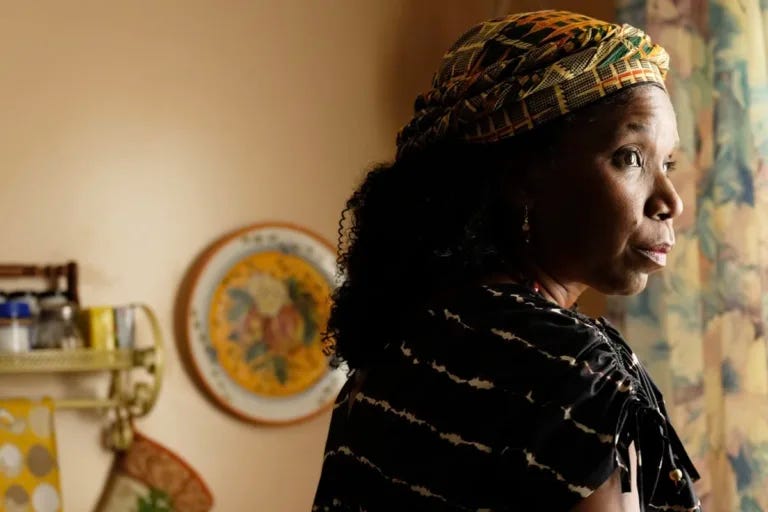
A grandmother trying desperately to protect the boy she raised.
She isn’t trying to crush Lamar’s dream because she doesn’t believe in him. She is terrified because she knows exactly what can happen to a young Black boy with a dream when that dream requires him to walk into dangerous rooms.
When Wanda pushes her to let Lamar work with Artillery, Gerty tells her:
“I got a tinderbox, and you keep trying to sell me matches.”
That line tells you everything. She’s afraid. And her fear shows up by saying no.
I loved seeing this family. Because stories about neighborhoods like this have too often acted as if violence erased connection and family. Here we see parenting, love, support. They are given permission to dream.
That may be what I loved most about The Drop.
I think about Lamar, he said:
“Why the fuck can’t anyone be special around here?”
There it is.
That’s the show for me.
Why can’t anybody be special around there?
Why can’t something extraordinary blossom in a place everyone else has already decided is broken?
Even Wanda has already been reduced to who she used to be. But she is fighting, and trying to make people see that she has value beyond her past.
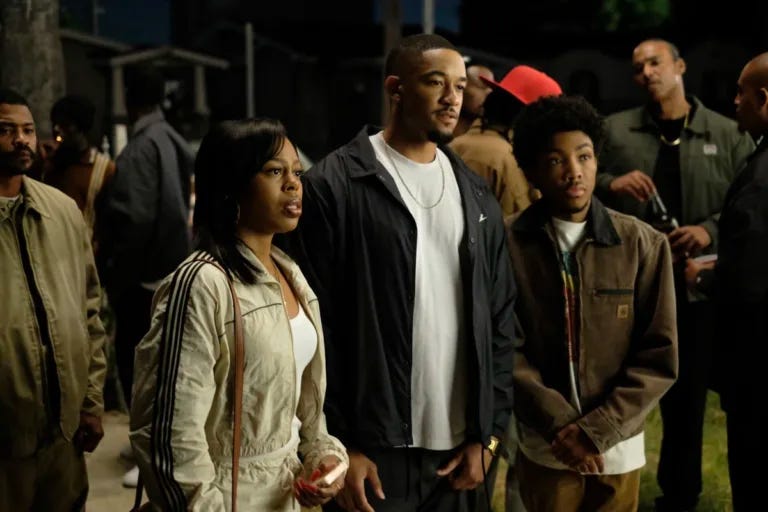
The Drop made me care about all of these people almost immediately because it doesn’t seem interested in judging them.
It understands them. So I understand them.
The episode closes with the sound that has been running through the entire hour.
A cassette. Click.
Cut.
I sat there thinking, damn. This is without a doubt a fat fucking hit of a show.
And underneath all of it, I kept coming back to this idea of a dream and a miracle.
Not the Hollywood miracle where Lamar becomes famous and Wanda gets a label and everybody gets rich. I mean that’s good too. But, I don’t know what’s going to happen to any of these people. The miracle happens before any of that. The miracle starts with somebody saying, I have a dream.
The miracle is believing you might be special when everything around you has taught you not to believe that at all.
The miracle is trying.
Whether the dream happens almost feels secondary.
I came into The Drop having never watched Snowfall.
I came in nervous because my friend was in it.
I came in knowing none of these characters.
By the end of Episode 1, like a good beat, it had its hook in me…and I was locked in.
- Victoria Bert // @victoriabnyc
The first episode was definitely good. Having Rance 1500 and Problem behind the music is a major plus too. 🔥🔥🔥
great review, searched The Drop just to see if anyone felt the same way i did! i definitely implore you to watch Snowfall, it’ll give Wanda’s character even more depth and it’s truly my favorite show of all time!