


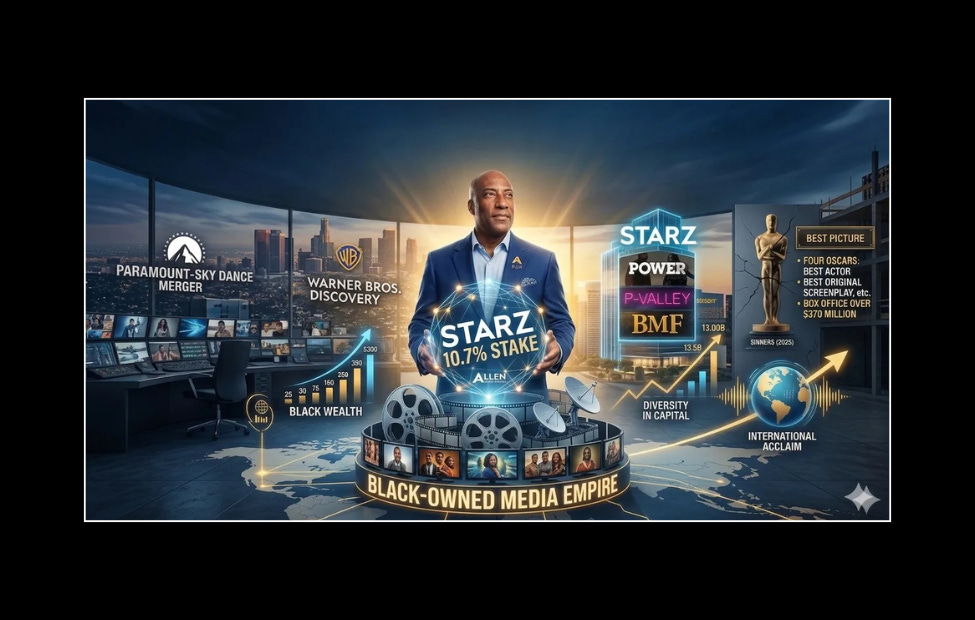
Although the Oscars’ has passed, the conversation surrounding Black and Brown-owned media platforms is more prevalent than ever. Currently, at the forefront, is Byron Allen. He is the Founder of the Allen Media Group, businessman, producer, and entrepreneur. In the week leading up to the Academy Awards, Allen acquired a 10.7% stake in Starz within a $25 million contract. From Power to P-Valley to BMF, Starz has often developed original Black film and television. Additionally, since May, Starz has been independently run by President and CEO, Jeffrey Hirsch.
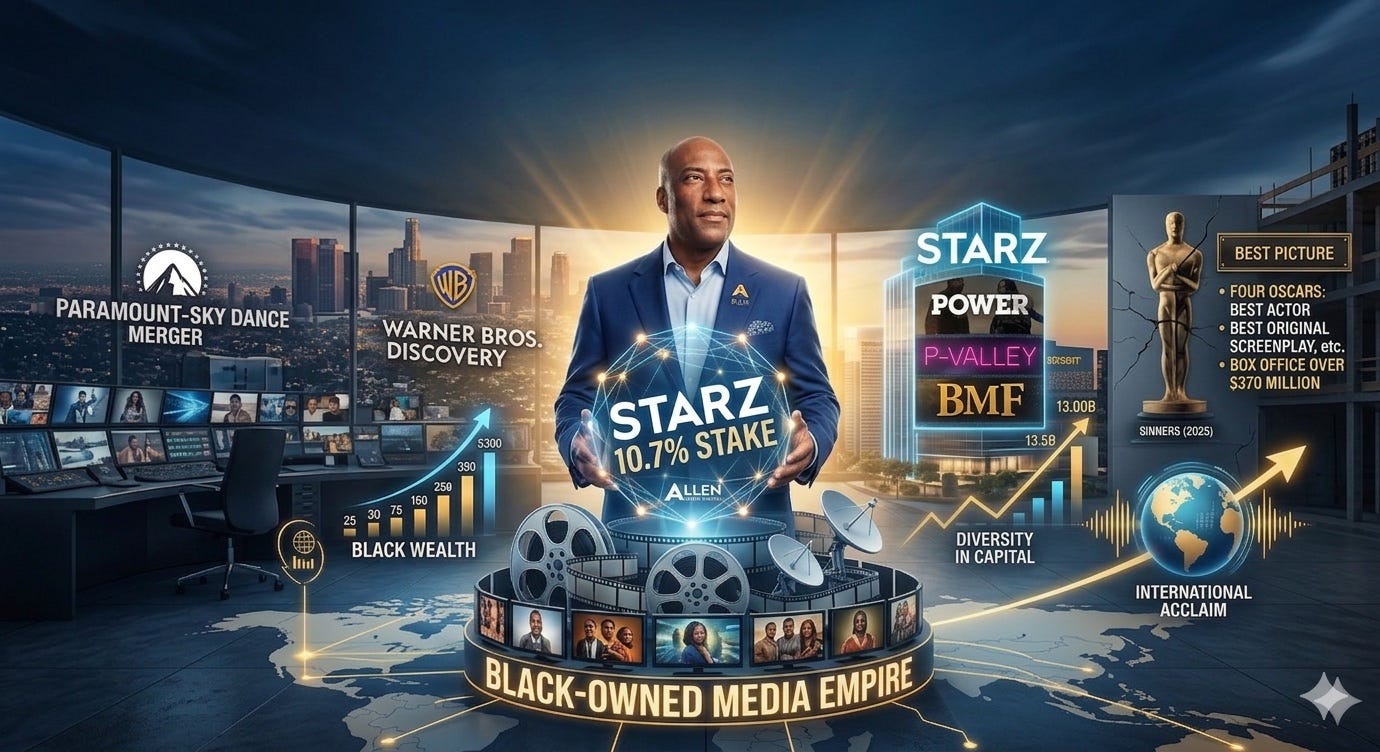
Allen’s acquisition is therefore not only influential, it is crucial. With the Paramount Skydance Corporation merger with Warner Bros. Discovery underway, there is much speculation around the future of Black film, television, and media.
For example, Ryan Coogler’s Sinners (2025) received sixteen Academy Award nominations and four Oscars for Best Actor (Michael B. Jordan), Best Original Screenplay (Ryan Coogler), Best Cinematography (Autumn Durald Arkapaw), and Best Original Score (Ludwig Göransson). As the owner of the multi-media company, Proximity Media, Coogler, along with producers, Zinzi Coogler, and Sev Ohanian, is the creative genius behind Sinners (2025). The film’s release revolutionized the landscape of Black speculative fiction. Moreover—given its international acclaim and a box office gross of over $370 million—why was Sinners not awarded Best Picture or Best Director?
While the successes are evidently earned, we cannot ignore the Academy’s pattern in awarding Black film. Over the years, the politics behind the screen have consistently influenced which Oscars’ are distributed. One might argue that cinematography, acting, screenwriting, and score, are all characteristics that make up the “best picture.” However, Paul Thomas Anderson’s One Battle After Another (2025) was chosen instead.
Time and time again, Black films have been awarded what The Academy “deems appropriate.” Consequently, filmmakers, lovers, and spectators alike, understand that Black film is mainstream and has always been. It has always had an impact on society in one form or another.
That being said—in order to continue to tell our stories—Black wealth and ownership must continue to be accumulated. Allen is only one of the Black billionaires’ making intentional, strategic moves in Hollywood. The more Black-owned media empires, the more diversity in voice and capital. It is one thing for Black storytelling to be financially supported, it is another for it to be verbally and socially championed. This is why we must simultaneously buy stake in entertainment infrastructure, while opening up our own independent companies in the process.
— Savanna Rust // @savanna_rust7